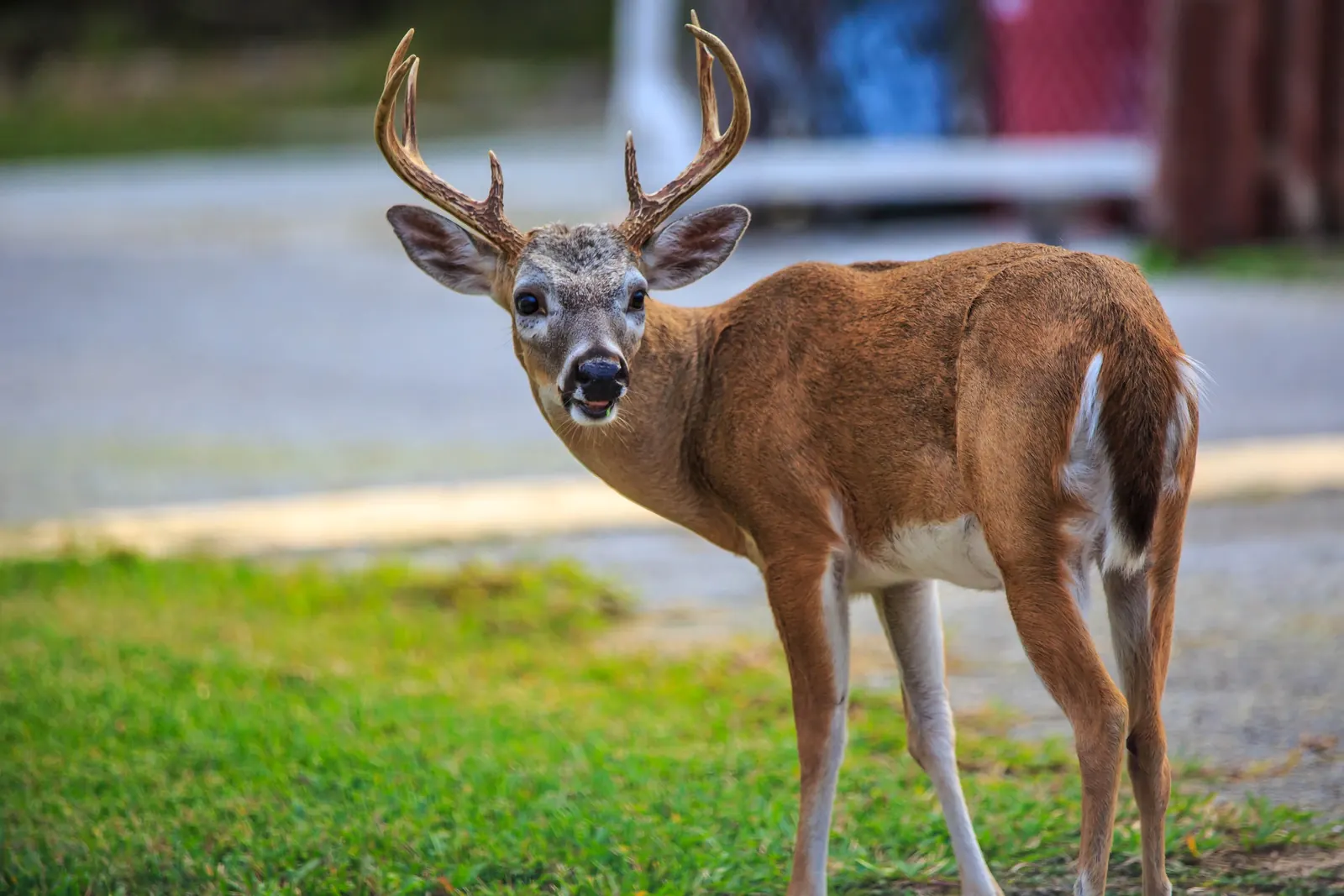
Which wildlife rules apply depends on which island you are on and whether you are on land or water. On land, the federal Key deer rules weigh most on Big Pine Key, where the deer are most often seen, and sometimes reach as far south as Lower Sugarloaf Key. Offshore, the Florida Keys National Marine Sanctuary sets the rules, and Looe Key is the sanctuary preservation area most tied to the Lower Keys. Feeding Key deer is illegal everywhere they range. Here is how the rules fall across the chain, from federal sources checked on November 23, 2026.
- The National Key Deer Refuge's tearsheet says Key deer are most often seen on Big Pine Key and sometimes south to Lower Sugarloaf Key, and that the refuge visitor center is on Big Pine Key. US Fish & Wildlife Service: Florida Key Deer tearsheet (2025)
- The Fish & Wildlife Service's 2025 Key deer tearsheet says the Key deer is federally listed as endangered, that deer are best seen at dawn or dusk throughout Big Pine and often south to Lower Sugarloaf Key, and that feeding them is illegal and bad for their health. US Fish & Wildlife Service: Florida Key Deer tearsheet (2025)
Where do Key deer live in the Lower Keys?
The Fish & Wildlife Service points visitors to dawn or dusk for seeing Key deer, throughout Big Pine Key and often south to Lower Sugarloaf Key. Its refuge tearsheet puts it a little more cautiously: most often on Big Pine Key, sometimes south to Lower Sugarloaf. The refuge visitor center is on Big Pine Key. The Key deer is federally listed as endangered.
The County’s land rules echo the same geography. Big Pine Key and No Name Key share one County planning area with its own Habitat Conservation Plan, and they are the only two islands where the County uses its Tier II transition category. Even a boat ramp listing carries the point: the state’s boating guide tells people using the Eden Pines ramp on Big Pine Key to watch out for Key deer.
- Monroe County plans Big Pine Key and No Name Key together as one Livable CommuniKeys area, with its own master plan and a Habitat Conservation Plan. Monroe County: Livable CommuniKeys Programs
- Monroe County says Tier II is a transition or sprawl-reduction area found only on Big Pine Key and No Name Key, and that there are no Tier IIIA areas on those two keys. Monroe County Planning & Environmental Resources: Tier System
- FWC's boating guide (survey February 2011) says the Eden Pines ramp on Big Pine Key is in a residential neighborhood with no parking available for cars or trailers, and warns to watch out for Key deer. FWC: Boating and Angling Guide to the Florida Keys, Eden Pines ramp
Which island has which wildlife rule on record
| Island or site | What the sources tie to it | Source on this page |
|---|---|---|
| Big Pine Key | Key deer most often seen; refuge visitor center; Tier II land; deer warning at the Eden Pines ramp | Fish & Wildlife Service, Monroe County, FWC |
| No Name Key | Shares the Big Pine plan and its Habitat Conservation Plan; Tier II land | Monroe County |
| Lower Sugarloaf Key | Southern edge of where Key deer are sometimes seen | Fish & Wildlife Service |
| Looe Key (offshore) | Sanctuary preservation area: no fishing, no taking marine life; free mooring buoys; anchoring due to be banned in 2027 | NOAA |
| Other Lower Keys islands | No island-specific wildlife rule in the sources we checked | None found |
The last row is a gap, not an all-clear. Refuge and sanctuary rules still apply wherever their boundaries run, and we did not reproduce those boundaries island by island. The Lower Keys map shows where each island sits.
- The marine sanctuary's zone boundaries are not reproduced here island by island. Use NOAA's own sanctuary maps before you anchor, fish or dive.
Is it illegal to feed Key deer?
Yes. The Fish & Wildlife Service says feeding Key deer is illegal and bad for their health. The refuge rules go further. They prohibit feeding, touching, capturing or harassing Key deer, alligators or any other wildlife, and they ask drivers to keep to the posted speed limits.
- The US Fish & Wildlife Service says refuge rules prohibit feeding, touching, capturing or harassing Key deer, alligators and other wildlife, and ask visitors to observe posted speed limits. US Fish & Wildlife Service: National Key Deer Refuge, Rules and Policies
What are the National Key Deer Refuge rules?
Beyond the feeding ban, the refuge keeps motorized vehicles off its trails and off-road, and that includes golf carts. Pets must be on a leash. Camping, campfires and hunting are not allowed, and neither are drones. Bicycles are barred from Blue Hole, the Nature Trails and the beach portion of Long Beach, so plan to walk those.
- The Fish & Wildlife Service refuge rules say no motorized vehicles are allowed on trails or off-road (including golf carts), pets must be leashed, there is no camping, campfires or hunting, bicycles are not permitted at Blue Hole, the Nature Trails or the beach portion of Long Beach, and drones are prohibited. US Fish & Wildlife Service: National Key Deer Refuge, Rules and Policies
These are federal refuge rules. They apply alongside the County’s land planning, which is covered on our building rules page.
What can I do at Looe Key Sanctuary Preservation Area?
You can dive, snorkel and boat at Looe Key, but you cannot fish. NOAA lists Looe Key as one of 17 sanctuary preservation areas in the Florida Keys National Marine Sanctuary. In these areas, fishing by any means is prohibited, and so is removing or possessing marine life. The areas have mooring buoys so boats can tie up rather than drop anchor on the reef.
Lobster hunters should note a related rule from the state. FWC says harvesting spiny lobster is prohibited at all times in the sanctuary’s no-take areas, and that a saltwater fishing license and a lobster permit are needed to harvest lobster elsewhere unless you are exempt. During the sport season, night diving is prohibited in Monroe County.
The 2027 sport season falls on July 28 and 29. FWC’s regular season then runs from Aug. 6 to March 31, with a daily bag limit of 6 per person and a carapace that must be larger than 3 inches, measured in the water. Neither season opens the sanctuary’s no-take areas, where lobster harvest stays prohibited all year.
- NOAA lists Looe Key as one of 17 sanctuary preservation areas in the Florida Keys National Marine Sanctuary; SPAs have mooring buoys, and fishing by any means and removing or possessing marine life are prohibited there, while diving, snorkeling and boating are allowed. NOAA Florida Keys National Marine Sanctuary: Sanctuary Preservation Areas
- FWC says that unless exempt, a recreational saltwater fishing license and a lobster permit are required to harvest spiny lobster, and harvest is prohibited at all times in no-take areas of the Florida Keys National Marine Sanctuary. FWC: Spiny Lobster (recreational regulations)
- FWC lists the 2027 spiny lobster sport season (mini-season) as July 28-29, 2027, the last consecutive Wednesday and Thursday of July, with a 6 per person daily bag limit for Monroe County, a carapace larger than 3 inches measured in the water, and night diving prohibited in Monroe County during the sport season. FWC: Spiny Lobster (recreational regulations)
- FWC lists the regular spiny lobster season as Aug. 6 to March 31 with a 6 per person daily bag limit and a carapace larger than 3 inches measured in the water. FWC: Spiny Lobster (recreational regulations)
Will anchoring be banned at Looe Key in 2027?
Yes, according to NOAA. Its sanctuary preservation area page says that in 2027 anchoring of any kind will be prohibited in SPAs, with six exceptions: Hen and Chickens, Cheeca Rocks, Newfound Harbor Key, Eastern Dry Rocks, Rock Key and Sand Key. Looe Key is not on that list. The mooring buoys described below are what NOAA already provides there.
- NOAA's SPA page says that in 2027 anchoring of any kind will be prohibited in SPAs except Hen and Chickens, Cheeca Rocks, Newfound Harbor Key, Eastern Dry Rocks, Rock Key and Sand Key. Looe Key is not on the exception list. NOAA Florida Keys National Marine Sanctuary: Sanctuary Preservation Areas
Are mooring buoys free in the Florida Keys sanctuary?
Yes. NOAA says the sanctuary’s mooring buoys are free and work on a first-come, first-served basis. Standard buoys hold vessels up to 59 feet. Looe Key SPA is one of the places with the larger 24-inch buoys, which take vessels from 60 to 100 feet.
- NOAA says mooring buoys in the sanctuary are available first-come, first-served at no cost, standard buoys support vessels up to 59 feet, and larger 24-inch buoys for 60 to 100 foot vessels are at Looe Key SPA among other places. NOAA Florida Keys National Marine Sanctuary: Buoy Program
How far offshore is Looe Key?
The sources disagree, and neither one is an official chart distance. Keys Weekly Events puts Looe Key about six miles south of Big Pine Key. The Bahia Honda park concession says 12 miles offshore from the Bahia Honda marina. They measure from different starting points, which explains some of the gap, but we print both and leave the chart to settle it.
- Two sources give different offshore distances for Looe Key: Keys Weekly Events says about six miles south of Big Pine Key, while the Bahia Honda concession FAQ says 12 miles offshore from the Bahia Honda marina. They measure from different points and the sources conflict; neither is an official chart distance. Keys Weekly Events (about six miles from Big Pine) and Coral Reef Park Company FAQ (12 miles from Bahia Honda marina)
Where are the sanctuary zones near each island?
We have not reproduced the sanctuary’s zone boundaries island by island, because a hand-drawn copy is the wrong tool for deciding where to anchor or fish. NOAA publishes its own sanctuary maps. Check them before each trip, and check FWC’s rules for whatever you plan to catch. For the ramps and parks where you can launch from each island, see our parks and water access page.
The State’s reasons for watching the Keys this closely are written into law. Florida Statute 380.0552 ratifies the Keys as an Area of Critical State Concern, and protecting the natural environment of the Keys is among the Legislature’s stated aims.
- Florida Statute 380.0552, the Florida Keys Area Protection Act, ratifies the designation of the Florida Keys as an Area of Critical State Concern. The Monroe County Planning and Environmental Resources page repeats that the State Legislature designated the Keys this way and adopted policies to control growth based on the Keys' carrying capacity. Florida Statutes 380.0552 (Florida Keys Area Protection Act), Florida Legislature
- Among the Legislature's stated intents in Florida Statute 380.0552(2) are protecting the natural environment of the Keys, promoting orderly growth in line with public facilities and services, and ensuring that the population of the Florida Keys can be safely evacuated. Florida Statutes 380.0552 (Florida Keys Area Protection Act), Florida Legislature
Where in the Lower Keys can I see Key deer?
The Fish & Wildlife Service points visitors to dawn or dusk, throughout Big Pine Key and often south to Lower Sugarloaf Key.
Source: US Fish & Wildlife Service: Florida Key Deer tearsheet (2025)
Can I ride a bike at Blue Hole?
No. National Key Deer Refuge rules say bicycles are not permitted at Blue Hole, the Nature Trails or the beach portion of Long Beach.
Source: US Fish & Wildlife Service: National Key Deer Refuge, Rules and Policies
Which sanctuary preservation areas will still allow anchoring after 2027?
NOAA says that in 2027 anchoring of any kind will be prohibited in SPAs except Hen and Chickens, Cheeca Rocks, Newfound Harbor Key, Eastern Dry Rocks, Rock Key and Sand Key. Looe Key is not on that list.
Source: NOAA Florida Keys National Marine Sanctuary: Sanctuary Preservation Areas
How big a boat can use a Looe Key mooring buoy?
NOAA says standard sanctuary buoys support vessels up to 59 feet, and Looe Key SPA is one of the places with larger 24-inch buoys for vessels of 60 to 100 feet. All are free and first-come, first-served.
Source: NOAA Florida Keys National Marine Sanctuary: Buoy Program
Dates, rules and hours can change. The organisers have the final word: Monroe County, Florida (official site)